The Horan Natural Area – an update

Beginning in 2017, the North Central Washington Audubon Society (NCWAS) began promoting ecological and social improvements in the Horan Natural Area. We studied the area’s history, explored earlier studies, and established connections with key Chelan County PUD (land owners) and Washington State Park personnel (area managers). We walked through the Horan frequently and engaged others along the way. We learned about the diverse views people have about what the Horan area is and how they relate to it.

Side channel at the south end of the Horan Natural Area. A historic Wenatchee River channel. Water levels fluctuate several feet as the Rocky Reach and Rock Island dams vary their operations. Photo by Bruce McCammon

The Horan is unique within the Wenatchee Valley. One hundred acres located alongside the two largest rivers in the area, the Wenatchee and Columbia and linked to many developed parks by the Apple Capital Loop Trail. It’s the only pseudo-wild area in the valley.

The place is amazingly diverse and people visiting the area consider it valuable and enjoyable. Quiet moments are possible even though you are flanked by a city’s hustle. A variety of birds sing and pose for viewing and photographs. Deer wander throughout the area. Runners pass by quickly, usually with a nod or quick wave of acknowledgment. Spiders and beetles forage on the viewpoints’ wooden rails. Native cottonwood, dogbane, and milkweed respond to each season, providing habitat for perching, foraging, and nesting.

A quiet moment in the Horan Natural Area. Photo of Eliot Scull used with permission. Photo by Bruce McCammon

NCWAS attended numerous public meetings to provide input about the possible improvements listed in a “vision paper”- return water to the ponds, develop a plan to reduce invasive plant species and promote native species, promote understanding of the Horan through bilingual education materials, and highlight/honor the significant history of Native Americans throughout time. We returned to these themes repeatedly.

One might ask, “how successful have we been?”  Is a meaningful amount of water flowing into the ponds? Have invasive plant populations been reduced? Are native plants expanding and doing well? Do we see see evidence of efforts to inform and educate visitors about indigenous history?  Are under-served communities enthusiastically welcomed to the area?

The answer to all these questions is, unfortunately, “no.”  

That’s truthful – but rather depressing.

And yet, good things happen. The City of Wenatchee recently re-introduced stormwater runoff to the Horan. This came after a decade of environmental review, permitting, and design of water quality treatments prior to water physically entering the Horan. During a period of extended rainfall, the stormwater system directed a substantial amount of water to the Horan in December 2025. Over a period of weeks, the ponds responded. Standing water expanded slowly in the ponds closest to the inflow.

Standing water in the Horan Natural Area. March 19, 2026. Photo by Bruce McCammon

Flows in the Wenatchee and Columbia Rivers also increased because of the heavy December precipitation. Groundwater associated with the higher river levels helped support the surface water inflow to the ponds. Jointly, the high river levels and stormwater inflow resulted in the first visible, ponded water in years. Vegetation responded and, today, the ponds are covered with cattails and other wetland plants.

As a reward for the ponds standing water, Red-winged Blackbirds appeared and began to nest. These birds offer proof that having water and riparian vegetation result in a cascade of ecological benefits. To add to this success, two Virginia Rails were recently heard (July 2026) in the pond-side cattails along the trail. It is unlikely that they would have been in the area without their preferred wetland, riparian habitat.

Red-winged blackbird in the Horan Natural Area. May 5, 2026. Photo by Bruce McCammon

Another high point in 2026 was the return of adult Bald eagles to the nest in the Black cottonwood gallery in the northern part of the Horan. Their use of the nest was cause for celebration after a couple of years when the nest went unused. Observers noted that the birds were incubating and, eventually, feeding young. But wait, there’s more. Two eagle chicks were rescued from a nest on a high-tension power tower and transplanted in the Horan nest – while the adult eagles were caring for their chick. Remarkably, the adults seemed to accept the new eaglets without any interruption to their normal behavior. The Washington State University College of Veterinary Medicine produced a very nice YouTube documentary of the rescue and transplant operation (click here). The Horan native cottonwoods provided the base for this remarkable event, proving their value for a wide variety of bird species – from kinglets to eagles.

Audubon’s efforts to improve ecological conditions in the Horan have publicly elevated the importance of the Horan at a time when the local population is growing and recreational use of publicly available lands is increasing. The 100-acre Horan area will become increasingly important as use increases. It is unfortunate that the Chelan PUD has stepped away from actively finding a sustainable supply of water to fill and support the ponds that they dug in 1990. It is equally unfortunate that the Washington State Parks managers seem to be leaning heavily toward turning the Natural Area into another developed recreation site, aggressively mowing roadside and riparian vegetation, much of it native and culturally significant. Audubon members continue to walk through the Horan, talk to others as we go, and encourage respectful management to allow natural processes to function as they will. We continue to look for ecological improvements and educational opportunities in the area and hope that the PUD and State Park managers will recognize the area’s potential and treat it accordingly. For them to publicly wear a white hat as the result of purposeful, light-handed management seems a reasonable outcome and future goal.

Horan pond, circa 2003. Photo by Mark Oswood

Bonaparte Meadows – A Rare Conservation Opportunity

 Photo – Karen Edwards,
http://www.facebook.com/KarenEdwardsConservationPhotography/

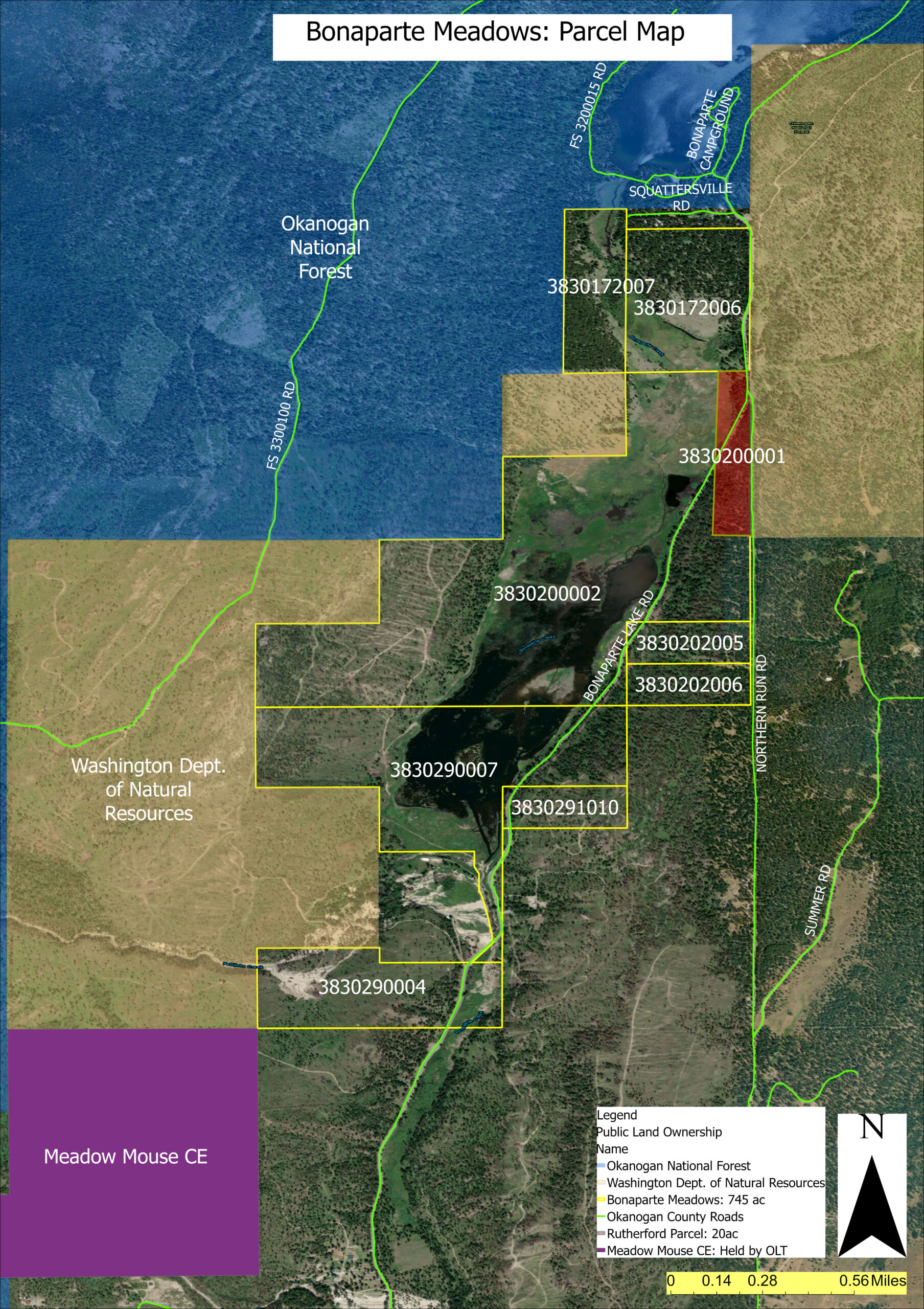
Bonaparte Lake, one of the few lakes in Washington that annually support breeding Common Loons, lies just a little south of the Canadian border in Okanogan County. Bonaparte Creek feeds out of it to the south, passing through nearby Bonaparte Meadows (technically, a “calcareous fen”, one of the rarest types of wetlands in the nation).

Okanogan/Wenatchee National Forest surrounds most of the Bonaparte Lake and Washington Department of Natural Resources lands are adjacent to portions of Bonaparte Meadows, so there’s already substantially connected public lands ownership in the area. The 745-acre meadows property (view map), however, is currently privately owned.

While the fen is the property’s signature feature, it hosts upland habitats as well and is an absolute biodiversity hotspot. A bird survey conducted there in May 2026 found 78 species, including nesting Bald Eagles, Golden Eagle, Blue-winged Teal, Barrow’s Goldeneye, Wilson’s Phalarope, and Williamson’s Sapsucker. Go to https://ebird.org/tripreport/526710 to read the full list. Future surveys will certainly add many more species to it.

The Bonaparte Meadows property is currently for sale. The good news is that Okanogan Land Trust (OLT) stepped up and has obtained an option to purchase it. If successful, acquisition of the property will secure the fen’s future as a critical biotic component of the uncommon mix of important habitats stretching from the lake to the meadows. Considering the property’s high diversity of birds, mammals, amphibians, and more, the chance of securing it for conservation is an opportunity we can’t afford to let slip away.

Photo by Janet Bauer, Winthrop

Fundraising for the potential acquisition is underway, with a deadline of July 31st. Of the $1,500,000 needed to complete the purchase, commitments of over $900,000 have been received, leaving approximately $600,000 yet to be secured. To lend a hand and help push this effort across the finish line, go to https://www.okanoganlandtrust.org/protect-bonaparte-meadows-3/.

June 10, 2026 – Banding Kestrel Chicks

Banding season has started as the American Kestrel chicks in the NCWAS’s Kestrel Nest Box Survey Project reach the appropriate age for banding – optimally between 14-24 days old. Through the banding effort, we hope to understand more about the survivorship of the young kestrels produced in our 2,000-square-mile study area, learn where they disperse, learn about their longevity, and see if surviving young birds are incorporated into the local population.

Today 45 chicks were banded by project leader Kent Woodruff with help from NCWAS members DJ Jones, Jen Fisher, Mike Sorensen, and Marilyn Hedges.

Transferring the chicks to a soft bag.
Determining age and gender.
Measuring for the leg band.
Chosing the band and documenting the process.
This chick is about 14 days old.
This 24 day-old chick shows off its new black leg band and needle-sharp talons.

This is the second year Kestrels have been banded in this project area. Each chick receives a numbered metal band on its right leg and a colored band for easier ID at a distance on its left leg. Blue was used for the colored bands in 2025 and black for 2026. Bird observers are encouraged to look for and report any Kestrels with colored leg bands. To date, one bird banded in 2025 as a chick was observed in the same project area in 2026 as a first-year adult.

This young Kestrel will be ready to fledge in about a week. NCWAS hopes that this project contributes to the population and understanding of American Kestrels.

NCW Audubon Society Donates $50,000 to Support Bonaparte Meadows Conservation Project

Okanogan County, WA — The NCW Audubon Society has announced a generous $50,000 donation to support the protection and restoration of the Bonaparte Meadows project, in partnership with the Okanogan Land Trust.

This significant contribution will help advance ongoing efforts to conserve Bonaparte Meadows, a vital landscape known for its rich biodiversity, critical wildlife habitat, and ecological importance within North Central Washington. The project aims to preserve native ecosystems, enhance habitat connectivity, and ensure the long-term health of the region’s natural resources.

“We are proud to support the Bonaparte Meadows project and the important work led by the Okanogan Land Trust,” said Art Campbell, president of the NCW Audubon Society. “Protecting this unique habitat aligns directly with our mission to conserve and restore natural ecosystems for the benefit of birds, wildlife, and future generations.”

The rarity of this wetland type and its critical support for wildlife diversity in Okanogan County are primary reasons why Okanogan Land Trust and NCW Audubon are seeking to preserve Bonaparte Meadows. The unique soil and water chemistry gives rise to equally unique plant species and combinations of species, including rare sedges, willows, and aster. The large and varied wetland habitat also attracts amphibians such as the priority species Columbia spotted frog and a tremendous variety of resident and migratory birds such as Barrow’s goldeneye. Many distinctive large mammal species of the region – from mule deer and moose to Canada lynx, wolves, and badgers – live on or move seasonally through the property between large areas of public land on either side.  

The Okanogan Land Trust will use the donation to further land conservation efforts, stewardship activities, and community engagement initiatives tied to the Bonaparte Meadows project. The funding will also help leverage additional support from partners and stakeholders committed to preserving the area.

“NCW Audubon Society’s contribution is a meaningful investment in the future of Bonaparte Meadows,” said Kate Miller, executive director of Okanogan Land Trust. “Their support strengthens our ability to protect this remarkable landscape and ensure it remains a thriving habitat for wildlife and a valued resource for our community.”

For more information about the Bonaparte Meadows project or to learn how to support conservation efforts, please visit https://www.okanoganlandtrust.org/.

2026 April Kestrel Nest Box Survey

Mike Sorensen uses a borescope to check a kestrel nest box on Barker Canyon Rd, Douglas Co.

We had good weather for our second April 2026 kestrel nest box survey in northern Douglas Co. Three weeks ago, on our first survey of the season, we made sure the boxes on our route were clean and had fresh wood chips, but despite the few kestrels along the way, no boxes were occupied. However, the kestrels have been busy since then. Today 9 of our 18 boxes were occupied, and 14 eggs were seen. In four boxes females remained on the nest when we peeked in with the borescope, potentially hiding more eggs. It will be interesting to check on these boxes again in 2 weeks.

View through the borescope – female kestrel and her eggs
Off in the distance, a female kestrel keeps an eye on us as we inspect an empty box. We hope we find it occupied on our next round in a couple of weeks.

On the Waterville Plateau the over-wintering Rough-legged Hawks are on their way North, replaced by Swainson’s Hawks newly arrived from their wintering grounds in Argentina. We saw five Swainson’s Hawks today. It seems to me that when they first show up in the Spring, they are especially slow to flush from whatever they are perched on when I step out of the car to take their photo. I’d be slow to get off my pole too if I had just flown many thousands of miles to get here.

A Swainson’s Hawk checks me out but is in no hurry to fly.

Early Spring at Upper Moses Coulee and Jameson Lake

Today, we saw something we have rarely seen in the 22 years we have been driving the road through Upper Moses Coulee – White-throated Swifts!  We had known they lived in the Coulee, but had very rarely seen them ourselves. So today, we were really excited to see them flitting around, up and down, over the basalt about a half mile north of the highway, where the scree juts out toward the road. They were fascinating to watch and impossible to photograph.

When we approach the scree, we usually always pull over, turn off the engine and step out of the car. We stand there and look and listen to see what we can observe. As we scan the wall, we see movement as something flutters in front of the basalt and lands on a rock. Sometimes binoculars tell us what it is, sometimes we have to take a photo with the big lens and enlarge the picture to see the field marks. This time it’s an American Kestrel, who is soon joined by a second. 

American Kestrel

As we sit there, we hear the song of the Canyon Wren, the Rock Wren, a Western Meadowlark, and a Say’s Phoebe. We hear the call of Sandhill Cranes as they fly overhead. Altogether, we observed ten species while standing there.

Canyon Wren singing its distinctive downward trill.

We continue on the road up towards the south end of Jameson Lake. The waterfowl are arriving in large numbers. We see all kinds of ducks – Mallards, Redheads, Ring-necks, Buffleheads, Hooded Mergansers, Ruddys, and well over 100 of those little black bobbers who are not ducks at all, but part of the Rail family, American Coots. 

At the lake we see more White-throated Swifts, along with Prairie Falcons, American Kestrels, and Red-tailed Hawks in a courtship display. Double-crested Cormorants glide over the lake surface.  

“Here’s looking at you,” says the Double-crested Cormorant.

We see three kinds of Blackbirds, Red-winged, Yellow headed, and Brewers.

Red-winged Blackbird

But the icing on the cake today was seeing two Golden Eagles flying overhead, one adult and one immature.

Adult Golden Eagle glides overhead
Immature Golden Eagle shows the white “windows” in its wings and tail.

The gate to the upper end of this part of the lake, the WDFW section, won’t be open until the end of the month. However, we won’t be going there then, as that is the beginning of fishing season. For the first couple of weeks the area is absolutely overrun with people. We will wait a bit and then go back during the middle of the week. 

Painted turtles enjoying the warmth of the sun.

This is just the beginning of the season. The neotropical migrants aren’t here yet. We haven’t seen the Osprey, and the Herons seemed to be hiding. They are probably up beyond the gate, where we can’t see them right now.

A list of everything we saw today:

Raptor Ramblings – Dry Falls Junction – February 2026

Cruising through Harrier Heights

Male Northern Harrier

Our North Cascades Audubon winter raptor surveys have yielded less birds this season than in past years. I am sure that one reason for this is the weather, which up on the Waterville Plateau, has been less than agreeable.  So many times there has been an abundance of heavy fog. Because of the fog, we’ve made multiple trips to our survey routes, hoping to get enough visibility to actually count raptors. 

We make a habit of looking at the WSDOT road cameras at Waterville and Sims corner before we leave. Those are the only cameras that are available to help us get some idea of what the weather is like 60 miles from where we live. So often the weather will be clear here in Wenatchee, even clear all the way to Moses Coulee, or Withrow. But then the fog rolls in and stays, and stays, and stays. When we can’t see a thing, we turn around and go home to wait for another day.

Hard to see much in this fog.

There have definitely been less birds this year and last year than in previous years. After we complete our final surveys next month, I’m going to draw up a spreadsheet with a chart to compare the number of raptors we have seen across the seven years this project has existed here in our part of the state.

This morning, we started out not seeing very much. We had traveled 36 miles on our route (96 miles from home) before we saw our first bird, an American Kestrel. Then, within a quarter mile we spotted a Rough-legged Hawk. After that…nothing. For ten more miles. We wondered if this was going to be a “Two-bird day.“

Rough-legged Hawk

However, once we got west of Saint Andrews Road, the Northern Harriers came out to play, or rather to hunt. The further we drove, the more we saw and our spirits began to lift. Before we finished our route we had counted EIGHT Northern Harriers, five males and three females. 

Male Northern Harrier

That made us feel a little better.

Today’s survey:
American Kestrel (AMKE)    3
Northern Harrier  (NOHA)   8
Rough-legged Hawk  (RLHA)  2

A Day in Section Six

Yesterday was seven and a half hours of creep, stop, scope, puzzle (what am I seeing in this flat light?), count, and record. 

The weather was dark and cloudy as we commenced our 2026 Christmas Bird Count day. We were thankful it wasn’t raining, it wasn’t snowing, and it wasn’t icy.

We cover section 6 of the Christmas Bird Count Wenatchee Circle, as shown above. The southern border of that section starts just below Ohme Gardens and travels almost 10 miles west along US Highway 2 to the intersection in Cashmere by Apple Annie’s Antique Mall. Section 6 is comprised of everything north of that line, as far as you can go, up into the landscape of Burch Mountain. 

This year, that covered 65 miles of roads around neighborhoods, orchards, and animal pasture. In an effort to reassure all of the neighborhood residents, as we stop and train our binoculars on their properties, we have three signs in the back windows of my car that say “Audubon Christmas Bird Count.” Most folks we encounter are friendly and wave at us. We wave back and smile.

I shouldn’t be, but I am always surprised that we never see the same thing this year as we saw the year before. When we drive up the road where we saw 50 White-crowned Sparrows last year, I’m surprised that they’re not still there! The 35 chickadees that occupied that shrubby corner last year have moved on. What’s more, the 238 California Quail that scampered across that field last year, are not still there waiting for us! Don’t they know we want to count them again?

However, this year did bring its own new surprises. It was exciting to find a total of 105 Cedar Waxwings, feasting on small berries! The orchards were full of Oregon Juncos and White-crowned Sparrows, hopping back-and-forth between the trees and the ground. 

This year brought an abundance of Robins. We’ve had very few Robins on our CBC in years past, and this year we counted 112!

We love it when we find raptors on our count day! This year we had six Cooper’s Hawks, one Sharp-shinned Hawk, four Kestrels, nine Red-tailed Hawks, three Bald Eagles, and a surprise…

We spotted a bird sitting on top of a cut off Douglas fir. Fortunately, it wasn’t spooked by us as we slowly drew closer. We scoped out its markings: bigger than an AMKE, smaller than a PRFA, the shape of its head, a very faint malar stripe… could this be a Merlin?  When it lifted off and flew away from the tree, and we spotted its checkered under-wing pattern, we had our confirmation of a Merlin! We’ve never seen a Merlin down in this neck of the woods, so we were extremely happy!

After the light was gone and the sun set, everyone gathered for a potluck and a review/compilation of everything that was seen. It’s always fun to chat about the day and discover what other people have encountered. Not to mention… the food is always excellent!

The stats for Section six of the 2026 Wenatchee Christmas Bird Count were 32 unique species and a total of 1,234 individual birds. Not bad for a very dark, flat-light day.

Mallards are opportunists

This photo is a simple view of a few Mallards on a pond. The scene is fairly common in our area whenever there is standing water. Give a Mallard a puddle and it is likely to make use of it.

But this photo represents much more than a simple view. These Mallards are part of about 25 that I saw on this pond during the hour I was there filming them. Again, this is not an uncommon situation. What makes this photo important and, hopefully, interesting, is that there is water in a pond in the Horan Natural Area. Yes, enough water has dropped onto or flowed into the Horan that Mallards are exploring areas that they have not accessed for a very long time.

The water has been evident for a week now thanks to unseasonably warm rains. I really do not think that the rainfall itself was sufficient to provide this much water to the Horan ponds. I’m a bit surprised, but I think a large part of the water seen here came from the City of Wenatchee stormwater drainage system. The system treats the water before it enters the Horan pond system and the inflow receives additional benefits from natural filtration in the wetlands that have been drying out for a considerable time.

So, it’s very rewarding for me to see this event – a couple of ducks on a pond. Common, but not so much in this area for years. All brought to you by the City of Wenatchee and the rains we’ve collected. While people in Cashmere and Leavenworth are recovering from floods, the waterfowl in the Horan are celebrating revitalized habitat. Ying and yang – that’s how water is many times. How long the pond water will remain is an open question. Time will tell.

Stormwater enters the Horan – 12.10.25

NCW Audubon has been working for years to improve habitat conditions in the Horan Natural Area. Many of the potential benefits we see come from reestablishing a source of water to the ponds and their associated riparian/wetland habitats. The pond system has been largely drying in recent years after termination of both stormwater entry from the City of Wenatchee and irrigation water from the Pioneer Irrigation Users system. Options to restore irrigation water supply to the area have been deemed infeasible by the Chelan PUD so the prospect of sufficient water to fill the ponds, or even a portion of them, is viewed as a long shot. NCW Audubon thinks this is highly regrettable.

The City of Wenatchee complied with a PUD request to cease direction of stormwater to the Horan Area based on a fear of accumulation of a variety of pollutants coming from parking lots and roads in Wenatchee. For over a decade, the stormwater was directed to a location near the Wenatchee River where it would be filtered by soil and rocks in the area. The City of Wenatchee applied to the Washington Department of Ecology (DOE) for funds to support design and installation of state-of-the-art filtration of the North Wenatchee Avenue stormwater system. At one point, the City’s application was the Number One request in the list of DOE list of candidates. The project was funded, and the City celebrated as they pulled the diversion barrier from the stormwater system so water could once again flow to the Horan.

Now, not to be overly optimistic, it only realistic to remember that the water is sporadic and will usually be small in amount. Yet, any water entering the Horan Natural Area will be put to beneficial use by the riparian and wetland plants that it reaches. My personal hope is that enough water is made available to support the key wetland that lies at the north end of the Horan area along the west edge of the area. This area is key to Wood Duck nesting and use. If the incremental water revitalizes or supports the wetland character of the area, we all win.

I recorded about 1.5 inches of rain at my house in Wenatchee over the last three days. I knew that the chances of seeing live water entering the Horan from the City storm drain system were pretty good. My short trip out the culvert crossing under the Loop Trail on Hawley Street was rewarding. I could hear flowing water before I saw it emerging from the box culvert as it entered the culvert to Horan. I visited the detention pond below the culvert outflow to learn that water was gracefully flowing out the east edge and into the Horan. It is unclear exactly where the water is going but it will likely be intercepted by the existing channel that runs north-south along the railroad alignment. Once in that channel, it may make its way north to the critical wetland. I’m hopeful.

My hat goes off to the City of Wenatchee for their persistence in finding a way to make this happen. Specifically, Jessica Shaw deserves a big shout-out for her success.

NCW Audubon has not totally given up on getting irrigation water back to the Horan. Our input about contemporary possibilities to do this are in the hands of the Federal Energy Regulatory Commission (FERC). We will all know the final outcome once the new Rock Island Dam license is issued.

You can watch water flow to the Horan in this VERY short video. It may be a small amount of water but it represents a significant success for the City of Wenatchee and Horan Natural Area. It’s fine to celebrate even a modest success.